Your heart beats about 100,000 times a day. It doesn’t ask for breaks, doesn’t ask for holidays, doesn’t warn you before it fails.
And yet, it’s one of the organs we screen the least regularly – until the day it’s too late to prevent.
A problem that is no longer “for the elderly”
The World Health Organization confirms that cardiovascular disease remains the leading cause of death globally, responsible for 17.9 million deaths per year.
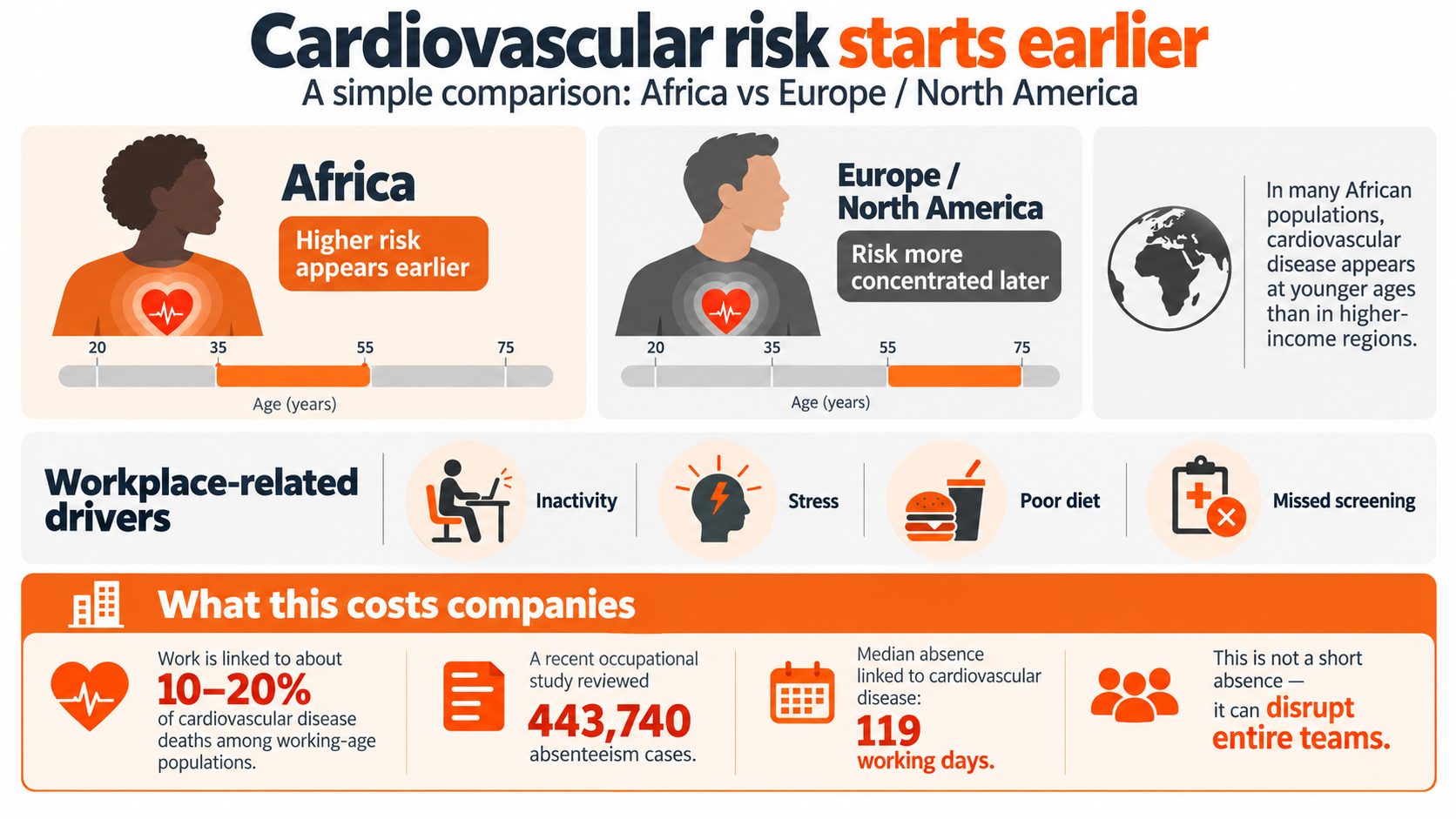
In Africa, the picture is particularly urgent: more than half of cardiovascular disease deaths on the continent occur between the ages of 30 and 69 – roughly ten years earlier than in Europe or North America. This is not, predominantly, a retirement-age problem. It is a working-age workforce problem.
What this costs companies
According to the CDC, workplace-related factors contribute to 10 to 20% of all cardiovascular deaths among working-age populations: inactivity, chronic stress, poor diet, lack of regular screening.
And the cost isn’t only human. A recent occupational study tracked more than 443,000 absenteeism cases and found that the median absence duration linked to cardiovascular disease was 119 working days. This isn’t an absence resolved in a week. It’s an absence that reorganises entire teams.
The logic any CFO recognises
An annual cardiovascular screening – blood pressure, lipid profile, blood glucose – costs a fraction of what a heart-attack hospitalisation represents in combined direct and indirect costs.
Prevention is not a symbolic gesture. It is the most defensible financial decision a company can make about its team’s health.
Mediplus covers cardiology consultations and cardiovascular screening across the entire national network. Don’t wait for a symptom to act.
Sources: World Health Organization, Cardiovascular Diseases Fact Sheet, 2024 · CDC, Workplace Health Promotion, 2024 · Cardiovascular disease and absenteeism in Dutch occupational health, 2025 · Global Heart Journal, Cardiovascular Diseases in Sub-Saharan Africa Compared to High-Income Countries, 2024